" fill="%23faf1da" stroke-width="1.8"/>%0A <ellipse cx="64.5" cy="50" rx="43" ry="12" transform="rotate(4 64.5 50)" stroke="%23938466"/>%0A <path d="m26 44 1 10m3-12 1 14m3-14 1 15m3-14 1 15m4-14 1 14m4-13 1 14m39-10-1 10m5-9-1 8m5-7-1 5" stroke="%23b2a181" stroke-width=".7"/>%0A <path d="M55 60c3-10 12-14 23-10l47-44c7-6 15-6 15-2 0 5-9 11-14 14L82 60c-8 4-21 4-27 0Z" fill="%23bc8c48" stroke-width="1.6"/>%0A <path d="M61 59c3-5 9-8 15-5l-4 7m8-8 49-45 6-4M84 52l45-41" stroke="%2376562e" stroke-width="1"/>%0A <path d="M20 53c18 14 69 19 90 2" stroke="%23514431" stroke-width="2"/>%0A <path d="M27 59c22 11 59 14 78 2" stroke="%23fff9e9" stroke-width="2"/>%0A <path d="m48 87 1 1m7 8 1 1m6-12 1 1m6 12 1 1m6-9 1 1m-24 9 1 1m19 4 1-1m10-16 1 1" stroke="%23aa9b7c"/>%0A </g>%0A</svg>%0A)
Basil Pesto
A coarse grind, cool basil, and a gradual stream of olive oil make a fragrant pesto with a cohesive but textured finish.
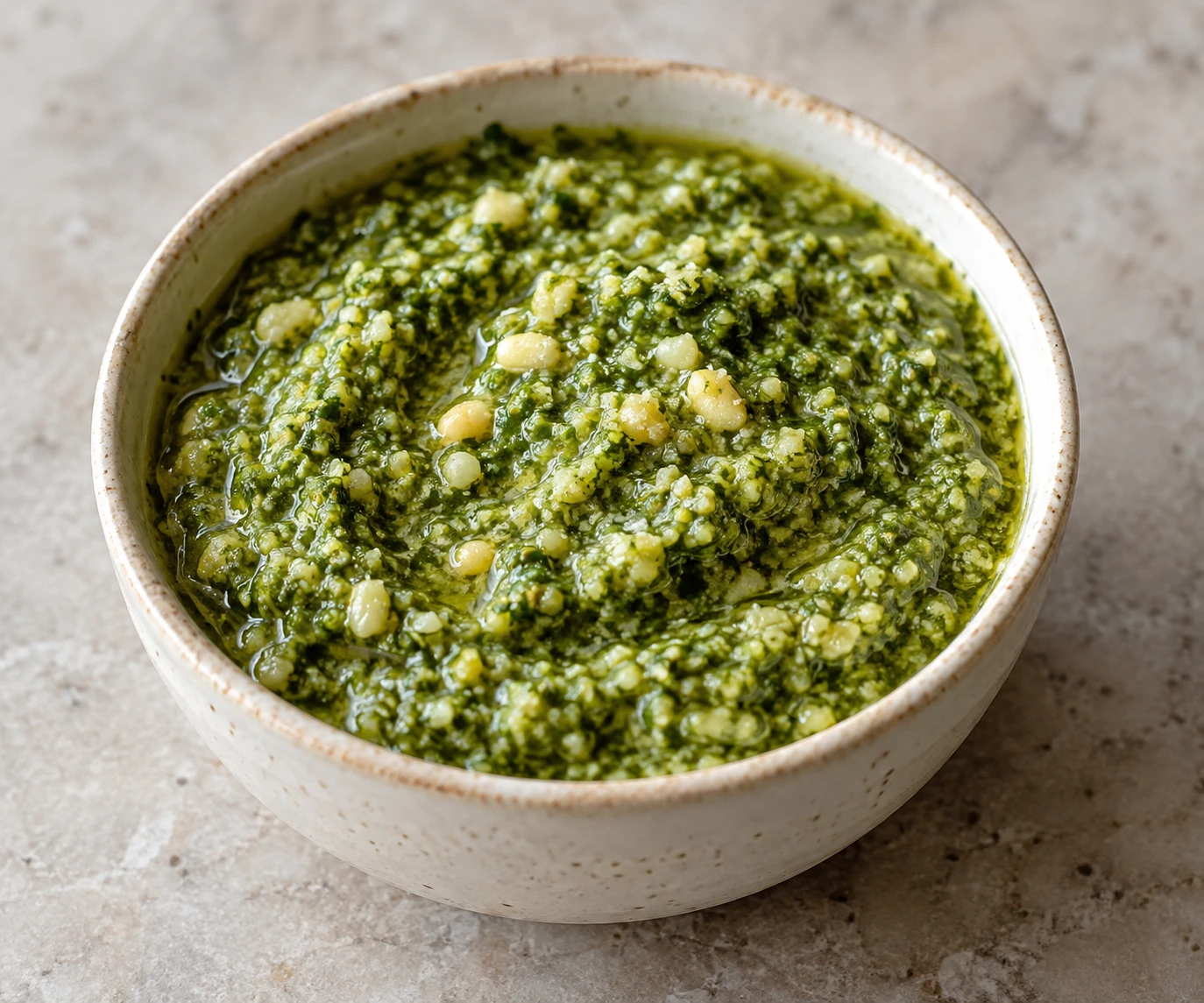
Basil pesto depends on careful handling more than extended processing. Keeping the leaves dry and cool helps their fresh aroma remain vivid in the finished sauce.
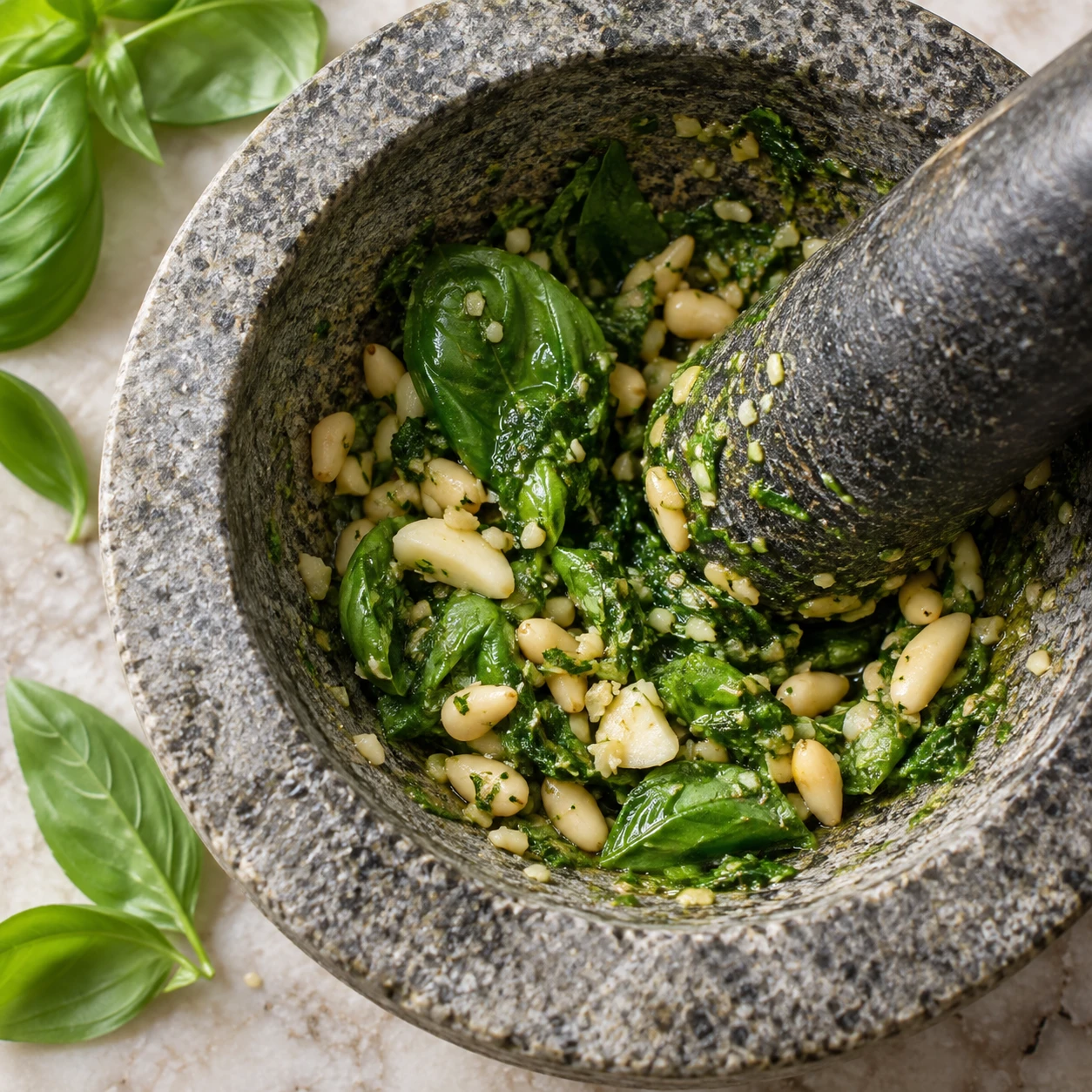
A mortar gives direct control over each crush, while a food processor can make the same sauce quickly when used in brief pulses.
Choose the texture as you grind
Pine nuts should break into coarse crumbs, and the basil should remain visible as small flecks. In a mortar, work against the bowl's side; in a processor, use brief pulses and scrape between additions.
Stopping before the mixture turns smooth keeps the sauce pleasantly textured. If the bowl warms during processing, pause so friction does not dull the basil's aroma.
Build an even emulsion
Once the Parmesan is mixed through, add olive oil slowly while stirring or working the mixture. A thin stream gives the oil time to disperse through the crushed leaves, nuts, and cheese.
Stop when the pesto looks cohesive and lightly glossy, with no clear pool collecting at the edge. Short mixing is enough once the oil is suspended.
Keep the basil's aroma bright
Dry leaves prevent stray water from loosening the emulsion, and completely cooled nuts keep residual heat away from the basil. The processor's motor can warm the mixture too, so use short pulses rather than a continuous run.
The finished pesto is a sauce in its own right and is best kept away from direct heat. Serve it at room temperature so its herbal aroma remains clear.
Read the finished texture
If oil gathers at the edge, stir or pound briefly until it is evenly suspended. If the sauce is rougher than you want, add only one or two short pulses or a few more strokes with the pestle.
Avoid extended processing to chase a perfectly smooth texture; it can warm the basil and make the pesto less aromatic.
Use either method
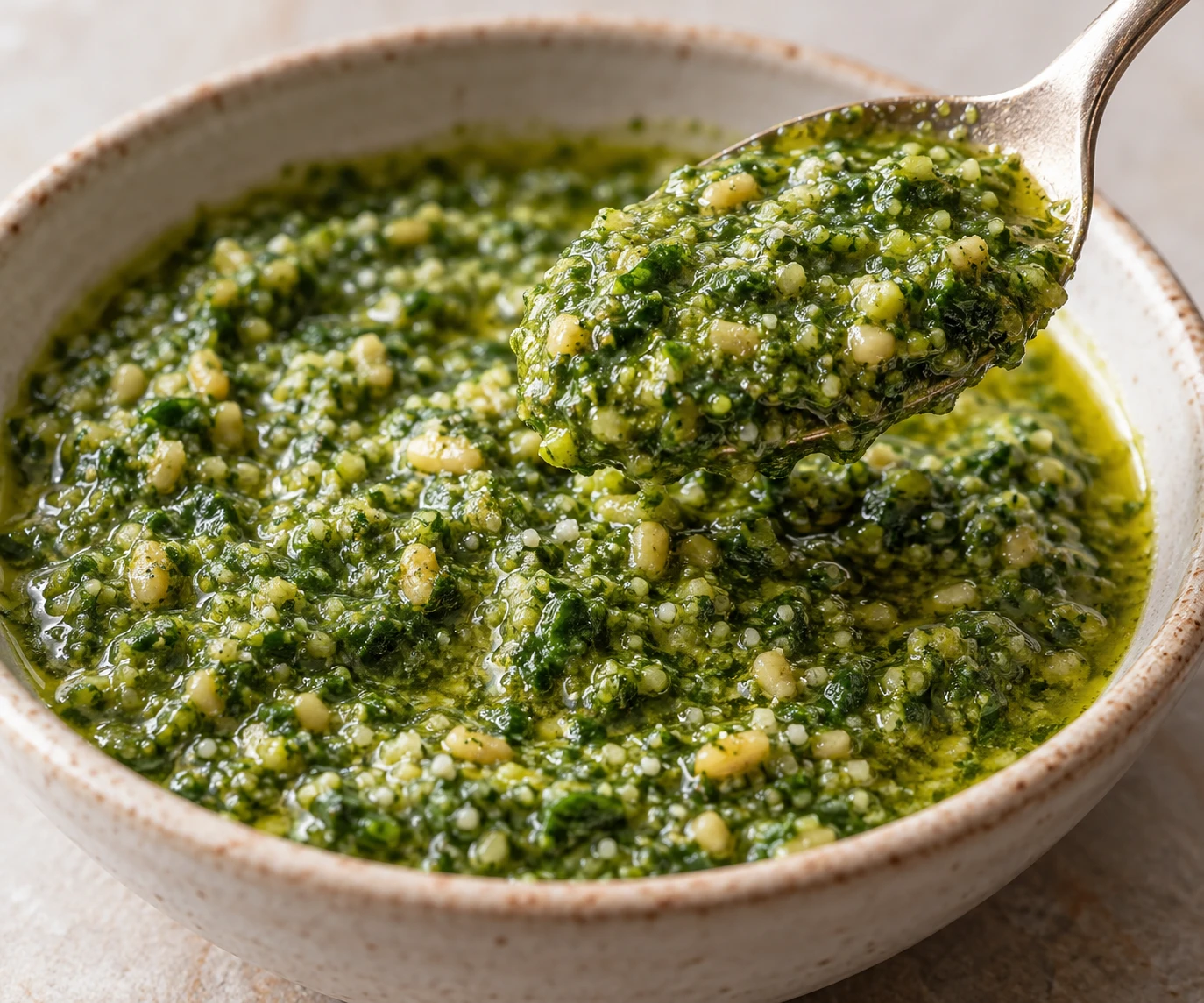
The mortar-and-pestle method lets you feel the change from whole leaves to a coarse paste, while the food processor reduces the effort. Both methods benefit from adding basil in batches and incorporating oil gradually.
Serve the sauce at room temperature on its own or alongside a meal. The recipe focuses on pesto itself rather than building it into a finished dish.
Basil Pesto
Ingredients
- • 2 packed cups (about 50 g) fresh basil leaves, washed and thoroughly dried
- • 1 medium garlic clove, peeled
- • 1/4 cup (35 g) pine nuts
- • 1/2 cup (45 g) finely grated Parmesan
- • 1/2 cup (120 ml) extra-virgin olive oil
- • 1/2 tsp fine sea salt
Method
Prepare the basil and cheese
Wash the basil leaves and dry them completely in a salad spinner or between clean towels; finely grate the Parmesan if needed and set both aside.
Look for: The basil leaves feel dry with no water beading in their folds.
Toast and cool the pine nuts
Toast the pine nuts in a dry skillet over medium-low heat for 2 to 3 minutes, stirring often, until lightly golden and fragrant; spread them on a plate to cool completely.
Look for: The nuts have a few golden patches and smell sweet, not browned or bitter. The nuts feel cool before they meet the basil.
Crush the garlic and salt
For the mortar method, pound the garlic clove with the salt to a moist paste; for a food processor, pulse them together until finely chopped, scraping down once if needed.
Look for: The garlic is evenly broken down and the salt is no longer in a separate pile.
Grind the pine nuts
Add the cooled pine nuts to the mortar and crush to coarse crumbs, or add them to the processor and pulse in short bursts; stop while small pieces remain rather than making a paste.
Look for: The nuts are broken into small, visible pieces with no oily smear.
Work in the basil
Add the basil in two or three handfuls, crushing it against the mortar wall or using brief processor pulses and scraping between additions; stop when the leaves are finely chopped but still visibly flecked.
Look for: The mixture is green and coarse, with recognizable basil flecks rather than a smooth puree. The processor bowl remains cool to the touch.
Add cheese and emulsify
Mix in the Parmesan, then incorporate the olive oil gradually: pound and stir in a thin stream by hand, or run the processor briefly on low while pouring through its feed tube; stop once the oil is evenly suspended.
Look for: The pesto looks cohesive and lightly glossy, with no separate pool of oil.
Check texture and finish
Taste the pesto and check that the salt is balanced; if it needs a finer grind, crush or pulse only once or twice more, then transfer it to a bowl and serve at room temperature as a sauce.
Look for: The pesto holds together on a spoon while retaining small basil and nut pieces. Its aroma is fresh and herbal, without a cooked or bitter note.