" fill="%23faf1da" stroke-width="1.8"/>%0A <ellipse cx="64.5" cy="50" rx="43" ry="12" transform="rotate(4 64.5 50)" stroke="%23938466"/>%0A <path d="m26 44 1 10m3-12 1 14m3-14 1 15m3-14 1 15m4-14 1 14m4-13 1 14m39-10-1 10m5-9-1 8m5-7-1 5" stroke="%23b2a181" stroke-width=".7"/>%0A <path d="M55 60c3-10 12-14 23-10l47-44c7-6 15-6 15-2 0 5-9 11-14 14L82 60c-8 4-21 4-27 0Z" fill="%23bc8c48" stroke-width="1.6"/>%0A <path d="M61 59c3-5 9-8 15-5l-4 7m8-8 49-45 6-4M84 52l45-41" stroke="%2376562e" stroke-width="1"/>%0A <path d="M20 53c18 14 69 19 90 2" stroke="%23514431" stroke-width="2"/>%0A <path d="M27 59c22 11 59 14 78 2" stroke="%23fff9e9" stroke-width="2"/>%0A <path d="m48 87 1 1m7 8 1 1m6-12 1 1m6 12 1 1m6-9 1 1m-24 9 1 1m19 4 1-1m10-16 1 1" stroke="%23aa9b7c"/>%0A </g>%0A</svg>%0A)
Red Wine Pan Sauce
Dry red wine and concentrated stock form a savory base, while cold butter gives this small-batch sauce its polished finish.
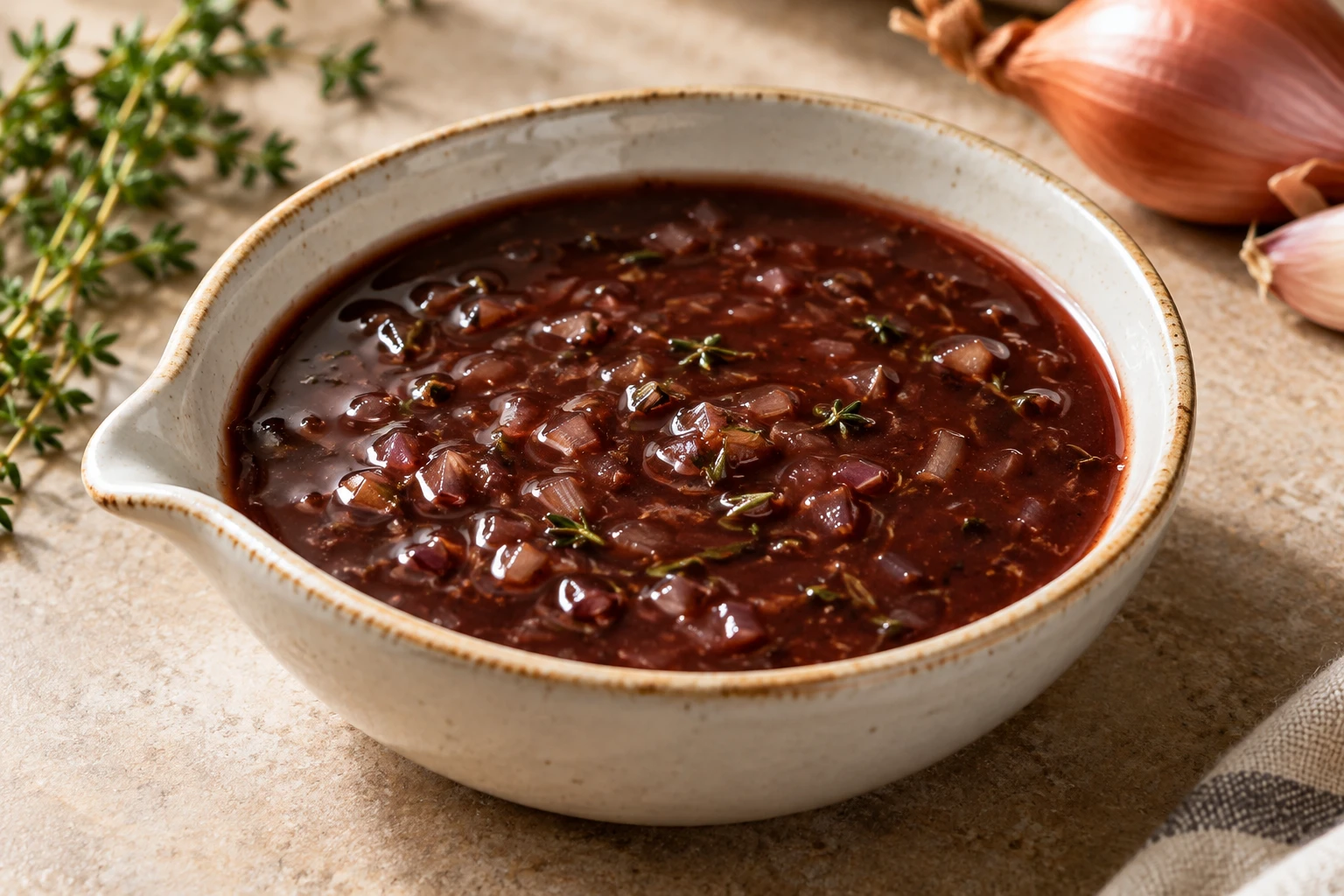
A pan sauce can be made on its own in a small skillet, so the technique does not depend on cooking meat first. Softened shallot, reduced wine, and stock create the savory base before cold butter is whisked in for a smooth finish.
Build a savory foundation
Mild heat softens the minced shallot in the first butter without browning it. This keeps the sauce aromatic and gives the wine a sweet, gentle base to reduce around.
Let the wine lift fond
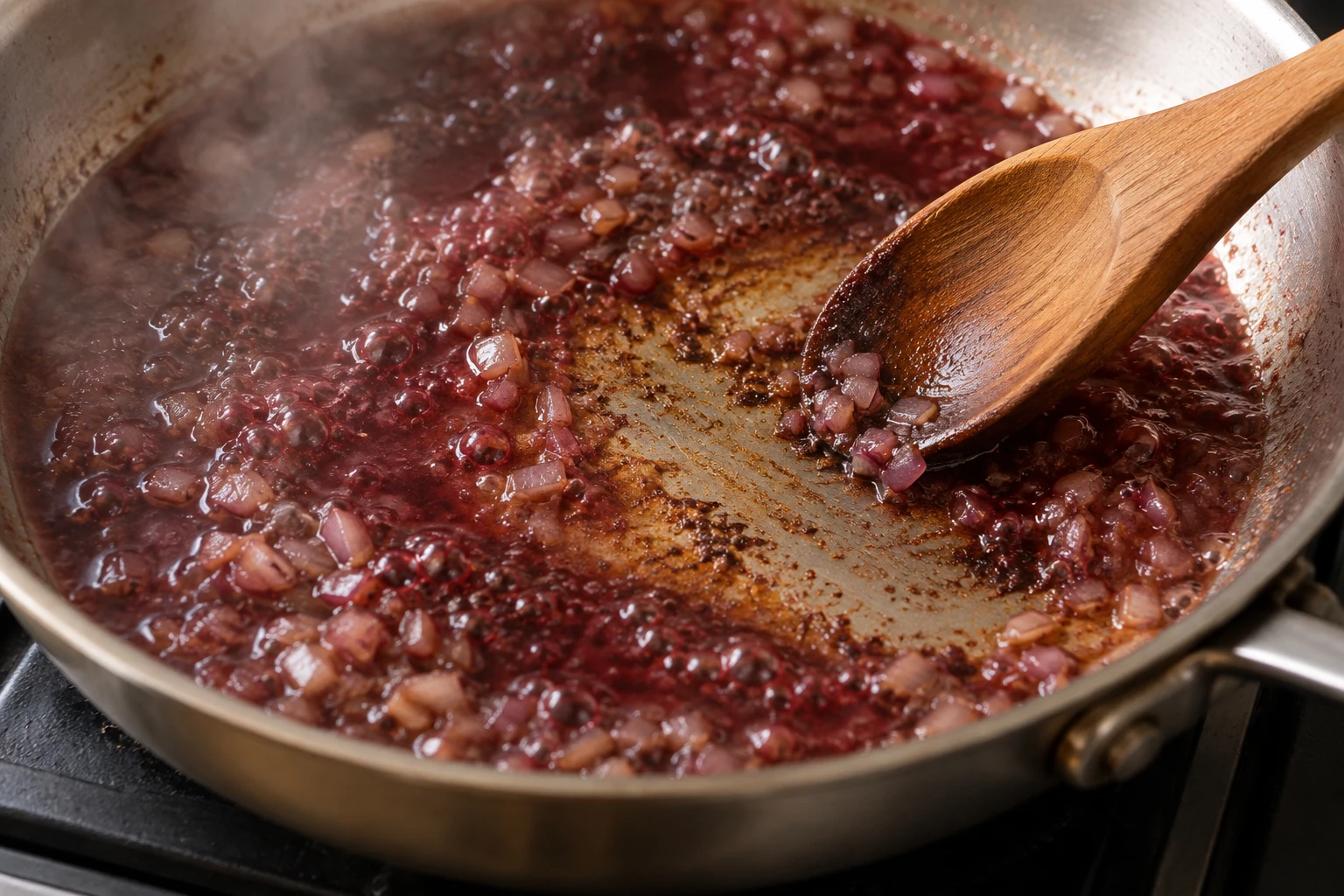
Pour wine into the hot skillet and scrape the base as it bubbles to release any browned fond. If the skillet is clean, continue the same reduction; fond adds depth, but it is not required for the sauce to work.
Read the reduction
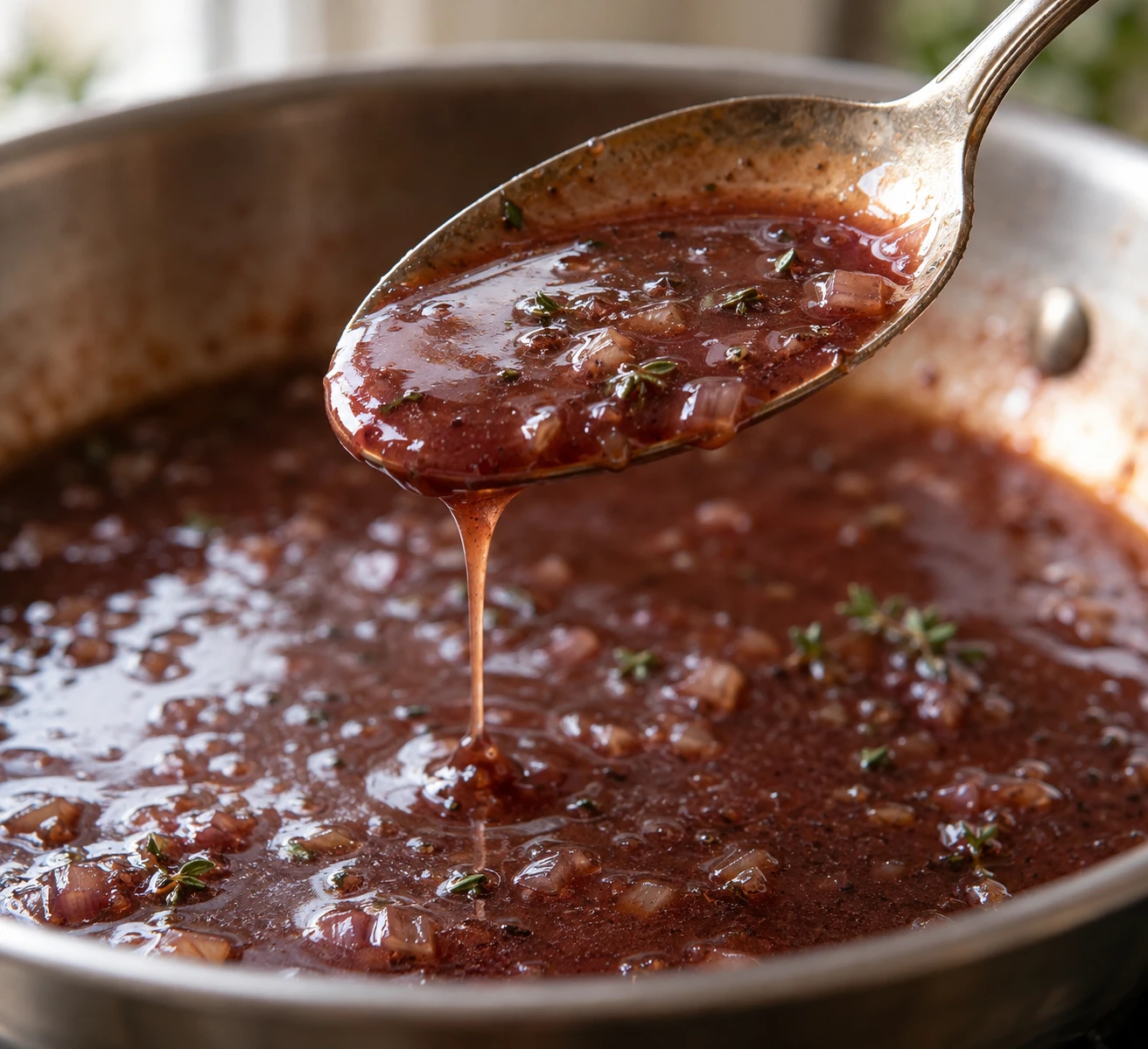
Reduce the wine until only a few tablespoons remain, then simmer the stock until it lightly coats a spoon. A finger-drawn track that holds briefly is a clearer signal than relying on the clock alone.
Whisk in the butter gently
Cold butter added a cube at a time makes the reduced liquid glossy and lightly thick. Keep the pan off the heat while whisking, and avoid boiling the finished sauce so the emulsion stays together.
Serve while glossy
The sauce is best served soon after it is finished, while its texture is fluid and polished. Roasted vegetables are an optional pairing that lets the sauce stand on its own as the focus.
Red Wine Pan Sauce
Ingredients
- • 1 tbsp unsalted butter
- • 1 small shallot, finely minced (about 2 tbsp)
- • 1/4 tsp kosher salt
- • 1/2 tsp freshly ground black pepper
- • 1/2 cup dry red wine
- • 3/4 cup low-sodium beef stock
- • 1 tsp fresh thyme leaves
- • 2 tbsp cold unsalted butter, cut into 4 cubes
Method
Prepare the ingredients
Mince the shallot, strip the thyme leaves from their stem, and cut the cold finishing butter into four cubes; keep the butter chilled until needed.
Look for: The shallot pieces are small and even, and the butter cubes remain firm and cold.
Soften the shallot
Set a small skillet over medium heat and melt 1 tbsp butter until it foams; add the minced shallot and cook, stirring, until translucent and soft without browning.
Look for: The shallot smells sweet and looks translucent, with no browned edges.
Deglaze with wine
Raise the heat to medium-high and pour in the red wine; as it bubbles, scrape the skillet with a wooden spoon to loosen any browned fond, if present.
Look for: The wine bubbles actively and any browned bits lift from the skillet as you scrape.
Reduce the wine
Boil the wine until only about 2 tbsp remain, stirring once or twice so the shallot does not stick; the skillet will look nearly dry around the softened shallot.
Look for: The sharp raw-wine aroma fades and the liquid forms a small pool rather than covering the pan.
Concentrate the stock
Pour in the beef stock and stir in the thyme; simmer until the liquid is reduced by about half and coats the back of a spoon, roughly 4 to 5 minutes.
Look for: A finger drawn through sauce on the spoon leaves a clear track for a moment.
Check the reduction
Lift out any thyme stems and test the sauce again; if it still runs like broth, simmer briefly longer, but stop while it remains fluid enough to pour.
Look for: The reduced liquid clings lightly to the spoon without looking sticky or syrupy.
Whisk in cold butter
Remove the skillet from the heat and whisk in the cold butter cubes one at a time, adding the next only as the previous piece disappears into the sauce.
Look for: The sauce turns glossy and lightly thickened, with no separate slick of melted butter.
Season and serve
Stir in the salt and black pepper, taste, and serve immediately; if the sauce cools before serving, warm it gently while whisking and do not let it boil.
Look for: The finished sauce is balanced, glossy, and fluid enough to spoon over roasted vegetables if desired.