" fill="%23faf1da" stroke-width="1.8"/>%0A <ellipse cx="64.5" cy="50" rx="43" ry="12" transform="rotate(4 64.5 50)" stroke="%23938466"/>%0A <path d="m26 44 1 10m3-12 1 14m3-14 1 15m3-14 1 15m4-14 1 14m4-13 1 14m39-10-1 10m5-9-1 8m5-7-1 5" stroke="%23b2a181" stroke-width=".7"/>%0A <path d="M55 60c3-10 12-14 23-10l47-44c7-6 15-6 15-2 0 5-9 11-14 14L82 60c-8 4-21 4-27 0Z" fill="%23bc8c48" stroke-width="1.6"/>%0A <path d="M61 59c3-5 9-8 15-5l-4 7m8-8 49-45 6-4M84 52l45-41" stroke="%2376562e" stroke-width="1"/>%0A <path d="M20 53c18 14 69 19 90 2" stroke="%23514431" stroke-width="2"/>%0A <path d="M27 59c22 11 59 14 78 2" stroke="%23fff9e9" stroke-width="2"/>%0A <path d="m48 87 1 1m7 8 1 1m6-12 1 1m6 12 1 1m6-9 1 1m-24 9 1 1m19 4 1-1m10-16 1 1" stroke="%23aa9b7c"/>%0A </g>%0A</svg>%0A)
Kuku Sabzi
Kuku sabzi turns an abundant pile of fresh herbs into a substantial Iranian-style frittata with toasted walnuts, tart barberries, and a crisp skillet edge.
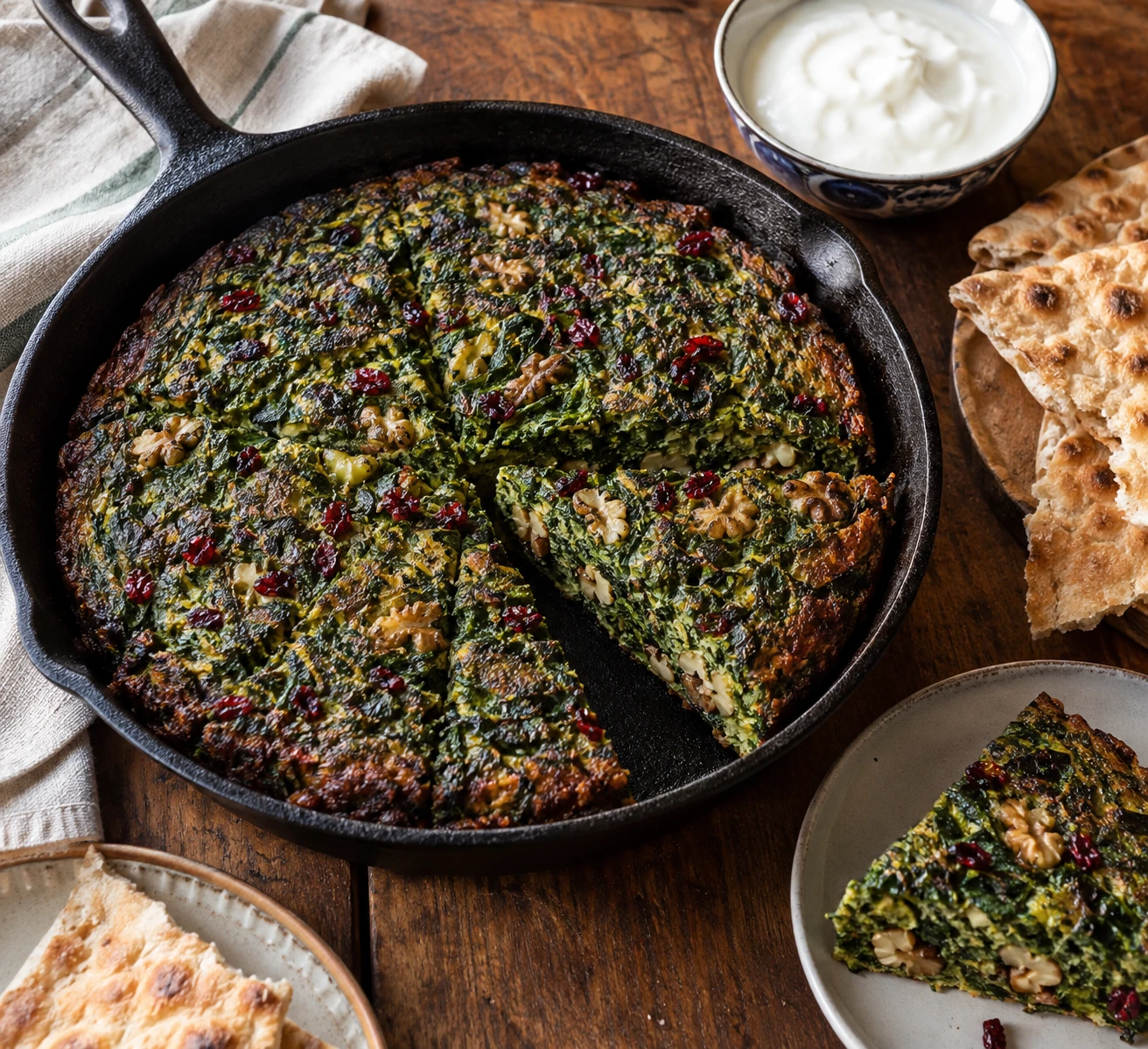
This is an egg dish led by herbs rather than eggs: parsley, cilantro, dill, and chives create the deeply green interior, while walnuts and barberries give it contrast. A short stovetop start firms the perimeter before a gentle oven bake sets the center without turning the kuku dry.
Dry the herbs completely
Fresh herbs carry more water than they appear to. Spin them dry and finish on towels before chopping, because water left on the leaves dilutes the eggs and softens the crisp edge that makes kuku sabzi so satisfying.
A green mixture with contrast
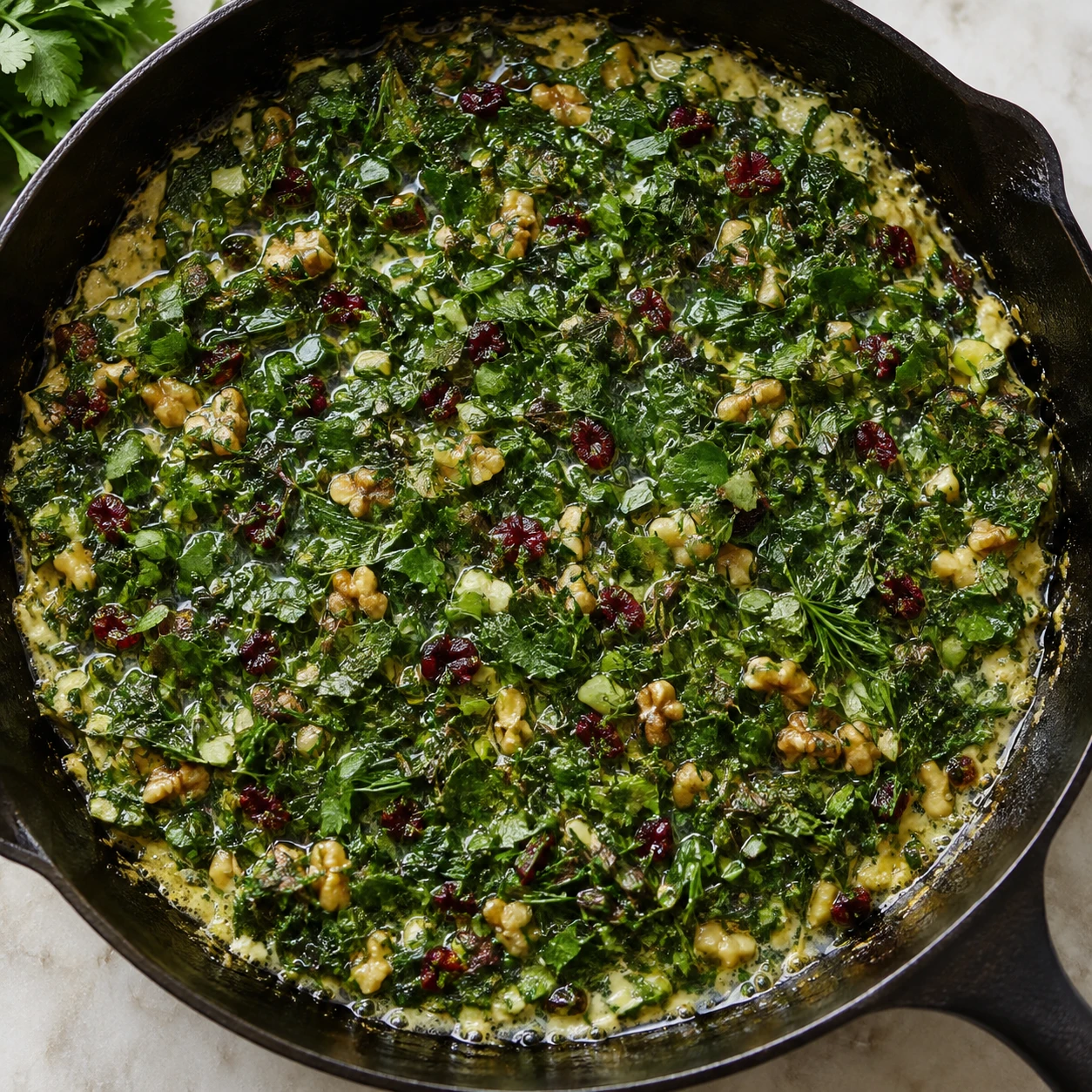
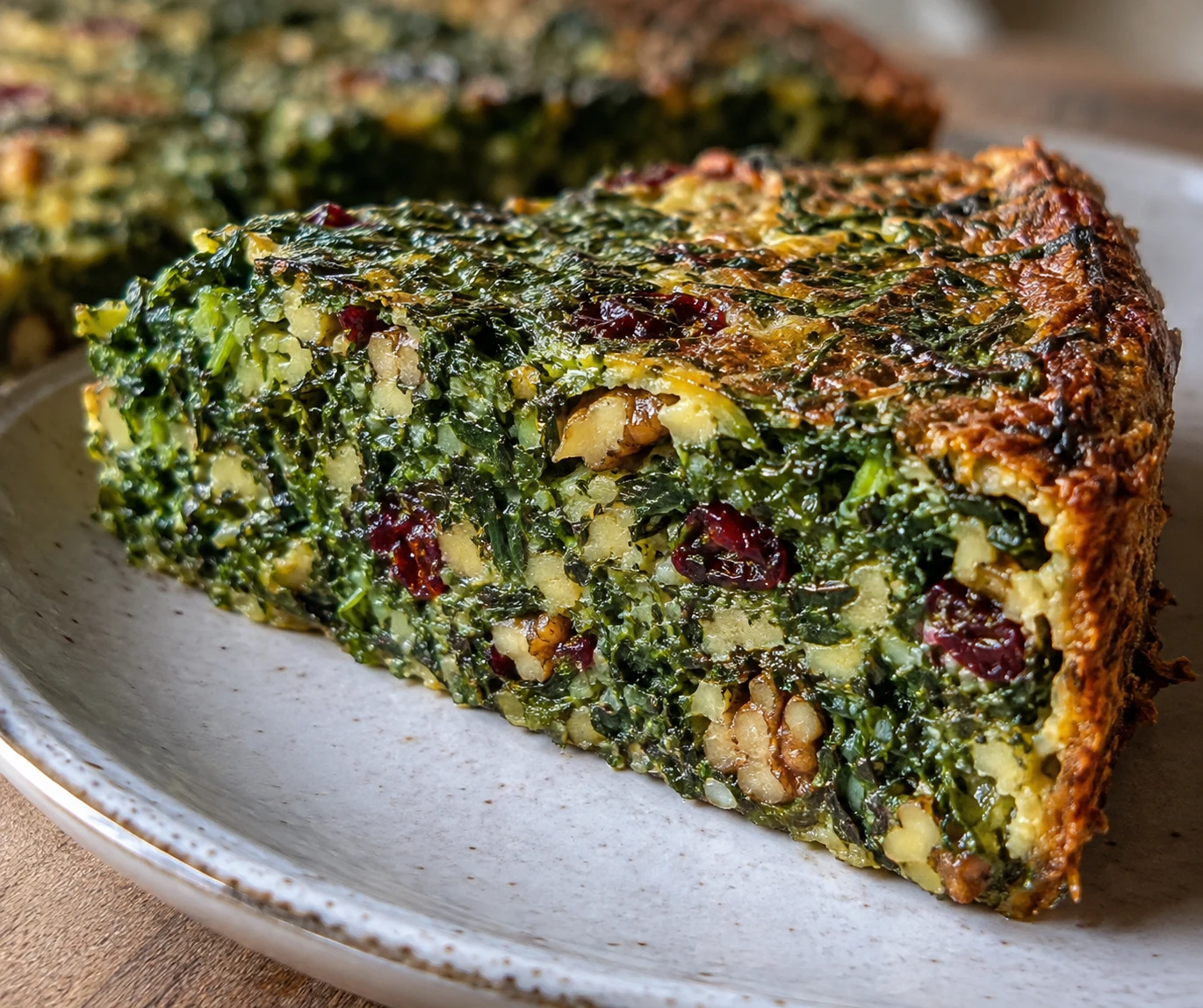
The bowl should look almost like chopped herbs held together by egg. Toasted walnuts remain pleasantly chunky in each slice, while dried barberries bring small tart bursts that keep the rich egg mixture lively.
Build a release-ready edge
Oil should reach up the skillet sides, not simply cover the bottom. Letting the perimeter set on the stove creates a sturdy edge, so a thin spatula can later slide around it without tearing the browned crust.
Read the center, not the clock
The useful doneness test is a gentle nudge of the skillet: the center should move as one soft mass rather than ripple like liquid egg. Pull it at that point, since the retained heat finishes the last bit during its rest.
Serve it on its own terms
Bring the skillet to the table for a relaxed brunch, or slide the kuku onto a board and cut it into wedges for a light meal. Plain yogurt and flatbread are enough alongside, and the dish remains appealing after it cools to room temperature.
Kuku Sabzi
Ingredients
- • 2 cups finely chopped fresh parsley
- • 1 cup finely chopped fresh cilantro
- • 3/4 cup finely chopped fresh dill
- •
- • 8 large eggs
- • 1 tsp kosher salt
- • 1/2 tsp ground black pepper
- • 1/2 cup toasted walnuts, coarsely chopped
- • 1/3 cup dried barberries
- • 3 tbsp olive oil, divided
- • Plain yogurt and flatbread, for serving
Method
Heat the oven
Set a rack in the center of the oven and heat the oven to 350 F, positioning a 10-inch ovenproof skillet nearby for the finished egg mixture. Use chives by default; use scallions when unavailable.
Look for: The oven signals that it has reached 350 F.
Dry the herbs
Wash the parsley, cilantro, dill, and chives or scallions if needed, then dry them very thoroughly in a salad spinner and on clean towels before finely chopping them.
Look for: The herbs feel dry to the touch and no water pools on the cutting board.
Mix the kuku
Whisk the eggs with kosher salt and black pepper in a large bowl, then fold in the chopped parsley, cilantro, dill, chives or scallions, toasted walnuts, and dried barberries until evenly distributed.
Look for: The egg mixture is densely green and the walnuts and barberries are spread throughout.
Oil the skillet
Warm 2 tbsp olive oil in the 10-inch ovenproof skillet over medium heat, swirling to coat the base and sides generously so the kuku releases cleanly after baking.
Look for: The oil shimmers lightly and leaves a visible slick up the skillet sides.
Start the edges
Pour in the herb mixture, smooth it into an even layer, and cook over medium heat for 4 minutes until the perimeter begins to set and sizzle without browning too darkly.
Look for: A narrow ring of egg at the edge looks opaque while the center remains glossy.
Bake until just set
Drizzle the remaining 1 tbsp olive oil over the surface, transfer the skillet to the oven, and bake at 350 F for 16 minutes until the center no longer sloshes when gently nudged.
Look for: The center is just set with a faint give, and the edges are crisp and browned.
Rest and loosen
Rest the kuku in the skillet for 10 minutes, then run a thin spatula around the edge and slide it onto a board or serve it directly from the skillet.
Look for: The kuku pulls away from the skillet edge and slices without releasing liquid egg.
Serve warm or room temperature
Cut the kuku sabzi into wedges and serve warm or at room temperature with plain yogurt and flatbread alongside.
Look for: Each wedge has a deeply green interior, browned edge, and visible walnuts and barberries.