" fill="%23faf1da" stroke-width="1.8"/>%0A <ellipse cx="64.5" cy="50" rx="43" ry="12" transform="rotate(4 64.5 50)" stroke="%23938466"/>%0A <path d="m26 44 1 10m3-12 1 14m3-14 1 15m3-14 1 15m4-14 1 14m4-13 1 14m39-10-1 10m5-9-1 8m5-7-1 5" stroke="%23b2a181" stroke-width=".7"/>%0A <path d="M55 60c3-10 12-14 23-10l47-44c7-6 15-6 15-2 0 5-9 11-14 14L82 60c-8 4-21 4-27 0Z" fill="%23bc8c48" stroke-width="1.6"/>%0A <path d="M61 59c3-5 9-8 15-5l-4 7m8-8 49-45 6-4M84 52l45-41" stroke="%2376562e" stroke-width="1"/>%0A <path d="M20 53c18 14 69 19 90 2" stroke="%23514431" stroke-width="2"/>%0A <path d="M27 59c22 11 59 14 78 2" stroke="%23fff9e9" stroke-width="2"/>%0A <path d="m48 87 1 1m7 8 1 1m6-12 1 1m6 12 1 1m6-9 1 1m-24 9 1 1m19 4 1-1m10-16 1 1" stroke="%23aa9b7c"/>%0A </g>%0A</svg>%0A)
Apple Pie
Cold butter and a patient cool help this double-crust apple pie bake up flaky, tender, and easy to slice.
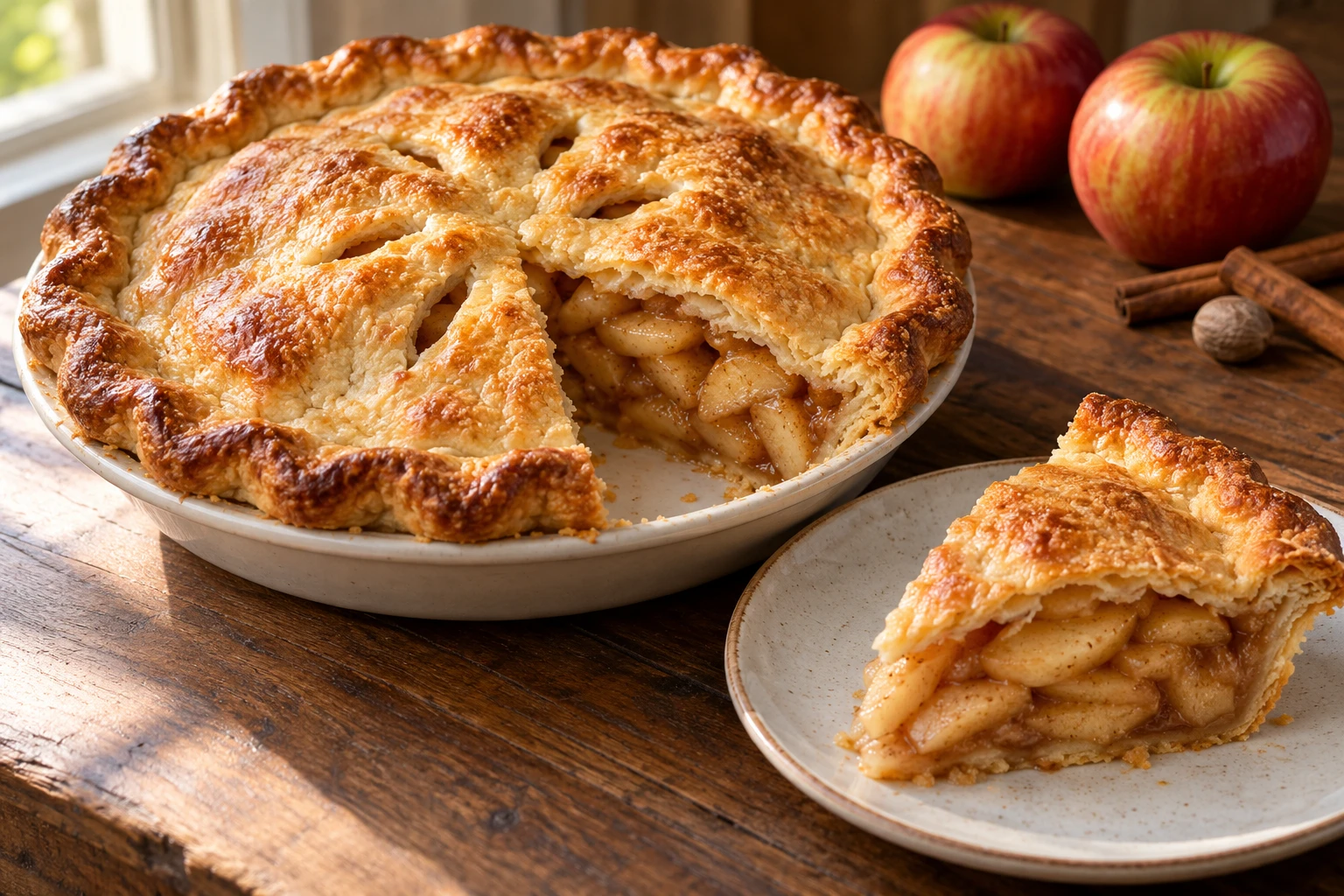
A good apple pie depends on contrast: crisp, buttery pastry around fruit that softens while keeping its shape. A brief rest after tossing lets the apples release juice before they go into the crust.
Build a flaky pastry
Work cold butter into the flour until small pieces remain, then add ice water only until the crumbs hold together. A light touch keeps the dough tender, while chilling makes it easier to roll and helps the layers stay distinct in the oven.
Season the fruit evenly
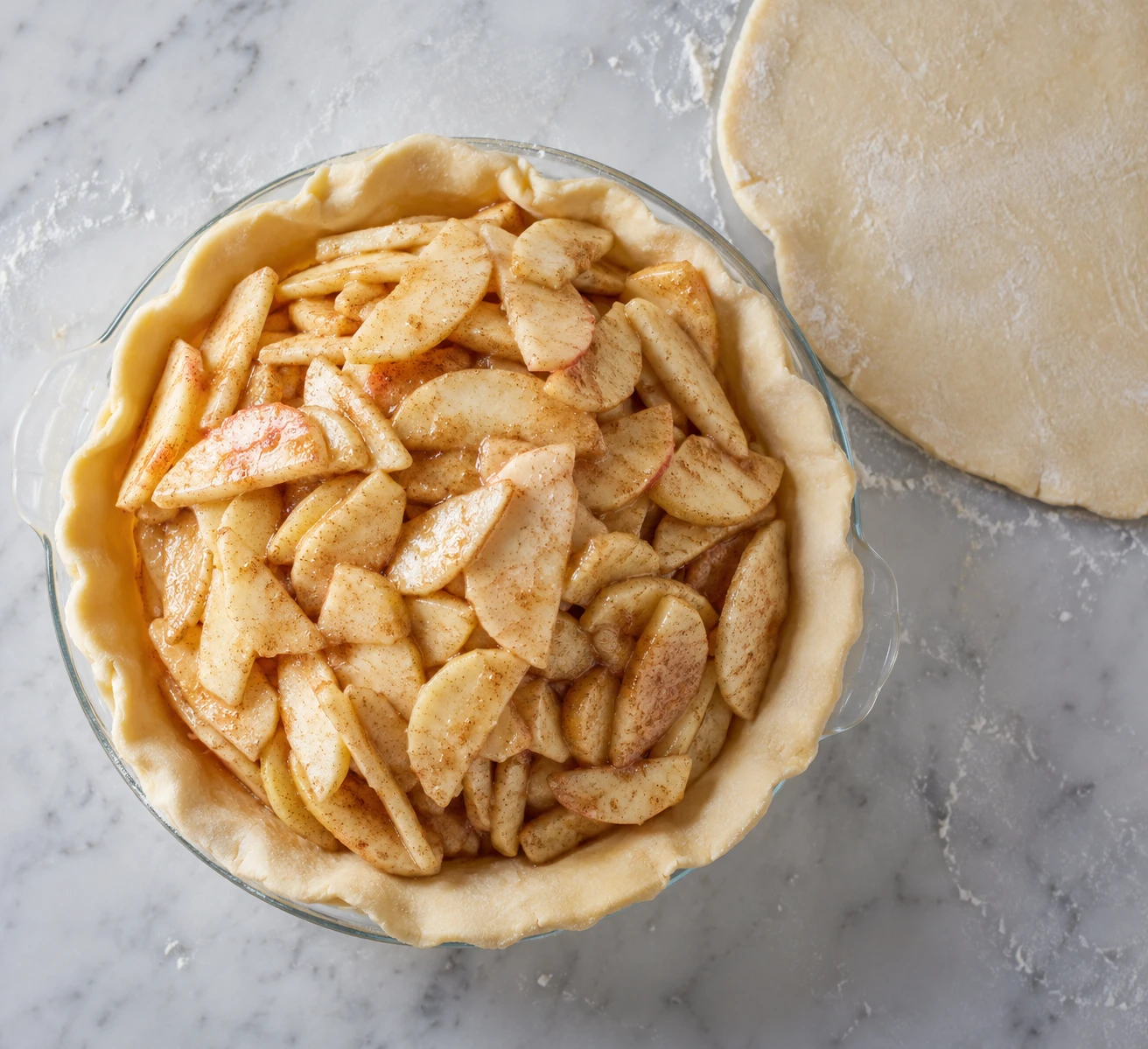
Firm baking apples soften without disappearing into sauce, so the finished slice still has a clear fruit texture. Sugar, lemon, cinnamon, and nutmeg season the slices, while flour thickens the juices as they bake.
Vent the top crust
A sealed, crimped edge holds the filling in place, and vents give steam a path out as the apples cook. Baking first at higher heat helps the pastry set; lowering the oven then gives the center time to bubble before the crust gets too dark.
Let the filling settle
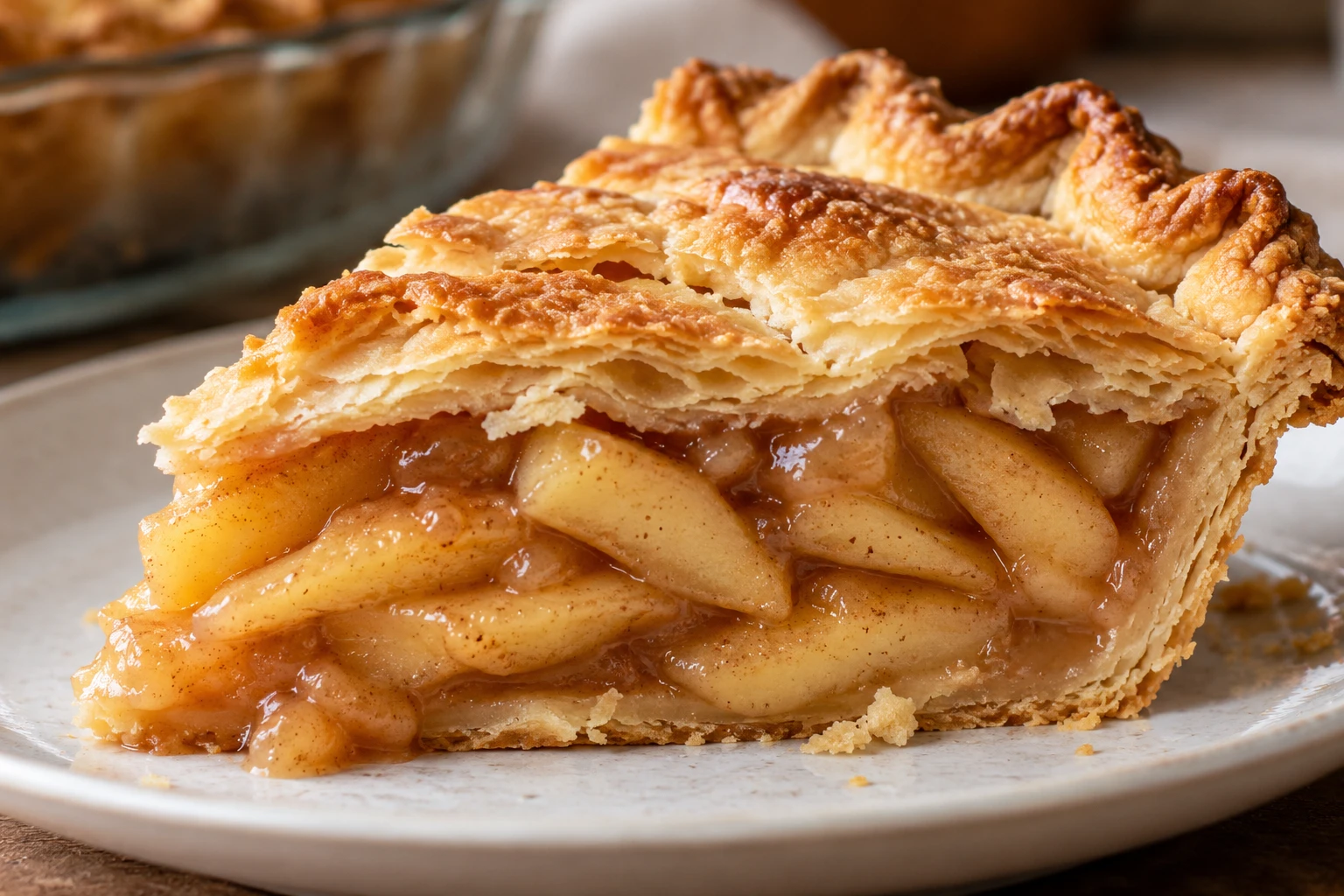
The pie needs a full cool before it is cut, because the hot juices are still loose when it leaves the oven. Once settled, slices lift cleanly and can be served at room temperature or gently warmed.
Apple Pie
Ingredients
- • 2 1/2 cups all-purpose flour
- • 1 tbsp granulated sugar
- • 1 tsp fine salt
- • 1 cup (2 sticks) cold unsalted butter, cut into small cubes
- • 6 tbsp ice water, plus up to 2 tbsp more as needed
- • 3 lb firm baking apples (about 6 large), peeled, cored, and thinly sliced
- • 2/3 cup granulated sugar
- • 1 tbsp lemon juice
- • 2 tbsp all-purpose flour
- • 1 tsp ground cinnamon
- • 1/4 tsp ground nutmeg
- • 1/8 tsp fine salt
- • 1 large egg
- • 1 tbsp water
- • 1 tbsp coarse sugar, optional
Method
Mix the pastry
Whisk the flour, granulated sugar, and 1 tsp fine salt in a large bowl. Cut in the cold butter with a pastry cutter until pea-size pieces remain, then drizzle in 6 tbsp ice water and toss; add up to 2 tbsp more, 1 tbsp at a time, just until pinched crumbs hold together.
Look for: The mixture looks shaggy, and a squeezed handful holds without feeling wet or sticky.
Chill the dough
Divide the dough into two equal portions, shape each into a disk, wrap, and chill for at least 45 minutes. The rest firms the butter and hydrates the flour so the pastry rolls without excessive cracking.
Look for: The wrapped disks feel firm but remain pliable around the edges.
Season the apples
Peel, core, and thinly slice the apples, then toss them with 2/3 cup granulated sugar, 1 tbsp lemon juice, 2 tbsp all-purpose flour, cinnamon, nutmeg, and 1/8 tsp fine salt. Let the mixture stand for 15 minutes while you roll the pastry.
Look for: The apple slices are evenly coated, and a little lightly thickened juice collects in the bowl.
Heat the oven and line the plate
Heat the oven to 425 F with a rack in the lower third, and set a rimmed sheet pan on the rack below the pie to catch drips. Roll one chilled disk on a lightly floured counter into a 12-inch circle, fit it into a 9-inch pie plate, and leave the overhang; keep the other disk cold.
Look for: The dough lies against the plate without stretching and extends evenly past its rim.
Fill and vent the pie
Spoon the apples into the lined plate, mounding them in the center, and pour over the collected juices. Roll the second disk into a 12-inch round, lay it over the filling, trim both crusts to a 1-inch overhang, tuck the edges under, crimp, and cut 5 or 6 vents across the top.
Look for: The top crust is sealed to the bottom crust, with distinct vents for steam to escape.
Brush and begin baking
Beat the egg with 1 tbsp water and brush a thin layer over the top crust and crimped edge; sprinkle with coarse sugar if using. Bake on the lower rack at 425 F for 20 minutes, until the crust starts to turn golden.
Look for: The pastry surface looks dry and its raised edges are beginning to color.
Bake until the center bubbles
Reduce the oven to 375 F and bake for 40 to 50 minutes more, rotating the pie halfway if one side browns faster. If the rim darkens before the center bubbles, cover it loosely with foil; the pie is done when the crust is deeply golden and thick juices bubble through the center vents.
Look for: Thick filling bubbles through the center vents, and the bottom crust looks golden where visible.
Cool before slicing
Transfer the pie to a wire rack and cool for at least 3 hours before slicing so the flour-thickened juices set. Serve at room temperature, or gently rewarm individual slices.
Look for: A cut slice holds its shape and the filling stays between the crust layers.